
If you are visiting Uttarakhand for Kedarnath, Badrinath, or Char Dham, Dhari Devi Temple is a sacred Devi temple you must visit at the beginning of your Yatra.
This guide explains Dhari Devi Temple location, history, legends, three forms, 2013 relocation, route importance and practical details, while clearly separating local beliefs from facts so you can plan your visit wisely.
Where Is Dhari Devi Temple Located?
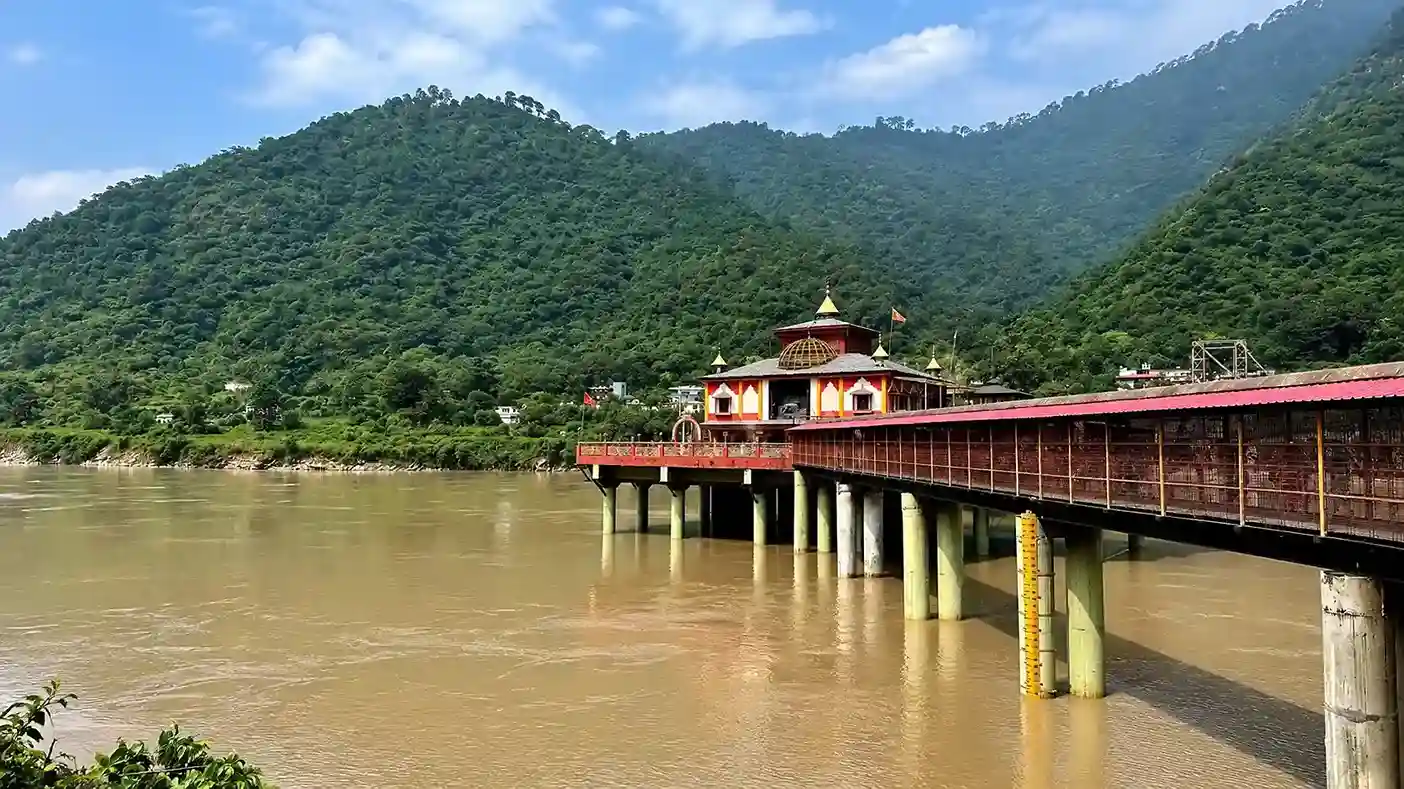
Dhari Devi Temple is in Kalyasaur village in Pauri Garhwal district, Uttarakhand, between Srinagar and Rudraprayag, beside the Alaknanda River. The shrine stands on a raised structure surrounded by the river.
Dhari Devi Temple Location
The temple is associated with Kalyasaur, in the Garhwal region. Road travellers generally approach from the Srinagar or Rudraprayag side before walking across the access bridge toward the shrine.
Dhari Devi Temple on Which River?
The shrine stands in the Alaknanda River, making its setting different from an ordinary roadside temple. The river, mountains and raised temple platform form an important part of the visitor experience.
Who Is Maa Dhari Devi?
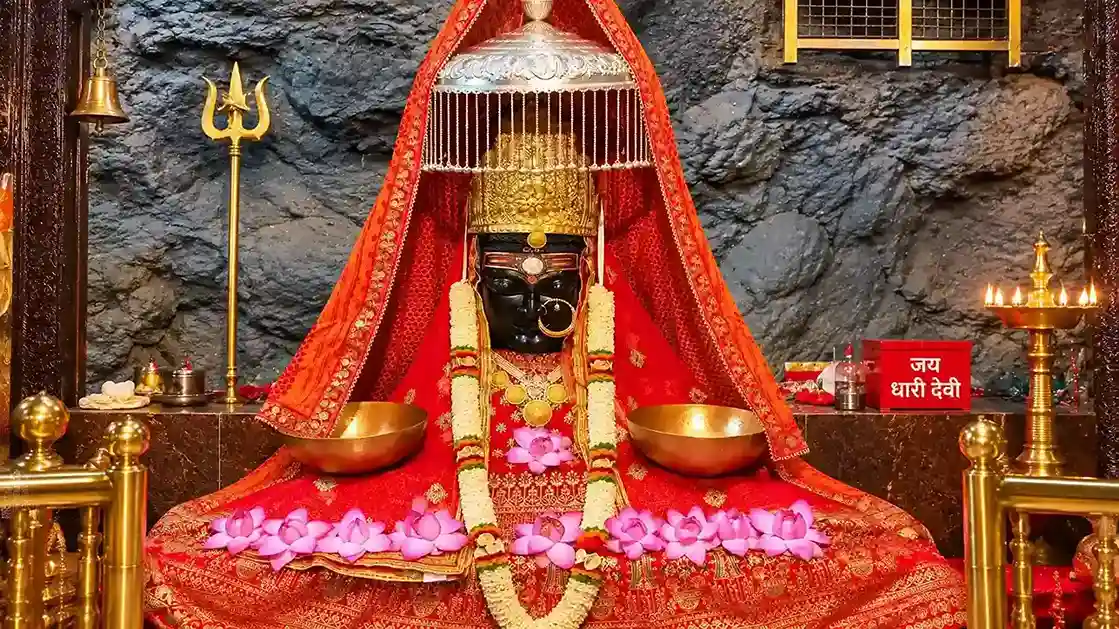
Maa Dhari Devi is traditionally revered as a manifestation of Goddess Kali and as a protective deity of Uttarakhand. Devotees particularly associate her with the protection of the Char Dham pilgrimage circuit. At the shrine, the upper portion of the sacred form is worshipped, while the lower portion is traditionally associated with Kalimath.
The Connection Between Dhari Devi and Kalimath
The religious tradition connects the two shrines through the divided form of the goddess. The upper portion is worshipped here, while the lower portion is revered at Kalimath as Kali.
Why Is Dhari Devi Temple Famous?
The Dhari Devi Temple is famous for several reasons, not just its riverside setting. Devotees associate Maa Dhari Devi with protection, the Char Dham pilgrimage, and Shakti worship. The temple is also known for the belief that her appearance changes during the day, her unusual origin story, and the controversy surrounding her 2013 relocation.
Guardian of the Char Dham
According to local devotional belief, Maa Dhari Devi protects Kedarnath, Badrinath, Gangotri and Yamunotri. This is why many pilgrims include darshan here while travelling through Uttarakhand.
Dhari Devi Temple History
The Dhari Devi temple history combines local religious tradition with more recent documented events. Its traditional history is instead preserved through the Dhari Devi story, local worship, and accounts surrounding the old shrine and its later relocation.
Old Dhari Devi Temple
The old Dhari Devi temple was associated with a rocky site near the Alaknanda. Unlike a conventional enclosed shrine, tradition describes the deity as remaining under the open sky at the original location.
The Dhari Devi Story: How Did the Shrine Begin?
The traditional Dhari Devi story tells of a girl who was the youngest among seven brothers. After their parents died, her brothers cared for her. An astrologer’s prediction allegedly led to fear within the family, and after misfortunes occurred, the brothers killed her and cast her divided body into the river.
How Did Maa Dhari Devi Reach Kalyasaur?
According to the legend, the upper portion floated downstream and reached the Kalyasaur area. A washerman reportedly heard a divine voice and was instructed to place the sacred form on a rock.
Why Is the Story Important?
The traditional Dhari Devi ki kahani explains why the goddess is connected with Kalyasaur and why her lower portion is associated with Kalimath. It is a sacred legend, not documented history.
Dhari Devi Face Changes: What Do Devotees Believe?
One of the most searched mysteries is the belief surrounding Dhari Devi face changes. Devotees traditionally say that the goddess appears in three forms during the day: as a young girl in the morning, a young woman during the afternoon, and an elderly woman later in the day.
Morning Form
The morning form is traditionally described as a young girl, symbolising childhood, innocence and purity. This is a devotional belief associated with Maa Dhari Devi.
Afternoon Form
During the afternoon, devotees traditionally describe the goddess as a young woman. The form is associated with youth, strength and grace.
Evening Form
In the evening, the goddess is traditionally believed to appear as an elderly woman, representing maturity, wisdom and the later stage of life.
Dhari Devi and the 2013 Uttarakhand Flood
The modern Dhari Devi temple history cannot be understood without discussing 16 June 2013. The idol was relocated in connection with a 330 MW hydroelectric project shortly before devastating flooding struck Uttarakhand. Devotees later connected these events spiritually, believing the goddess was displeased by being moved from her original abode.
Why Was the Idol Moved?
The supplied sources state that the original shrine was relocated to make way for the hydroelectric project. The present shrine is positioned on a raised man-made structure.
What Do Devotees Believe About the Flood?
The belief that relocating Maa Dhari Devi caused the disaster is a religious interpretation. The timing is part of the temple’s modern story, but the flood itself should not be presented as scientifically caused by the idol’s movement.
The Old and New Shrine
Searching for Dhari Devi old temple, Dhari Devi new temple, and Dhari Devi temple old pics usually reflects interest in how the shrine changed after 2013. The old setting and present raised structure are important parts of understanding the temple today.
Is Dhari Devi a Shakti Peetha?
Dhari Devi is widely described in devotional sources as one of the 108 Shakti Sthals. However, different traditions use the terms Shakti Sthal and Shakti Peetha differently.
The Sacred Form of the Goddess
At Dhari Devi, devotees worship the upper portion of the sacred form, while the lower portion is traditionally associated with Kalimath. This unusual connection is an important part of the temple’s religious identity.
Why Is Dhari Devi Called the Guardian of Char Dham?
For generations, devotees in Garhwal have regarded Maa Dhari Devi as a protective presence over Uttarakhand and the Char Dham pilgrimage route. The four major shrines are Kedarnath, Badrinath, Gangotri, and Yamunotri. This belief explains why pilgrims often include the temple in their journey before continuing deeper into the mountains.
Dhari Devi and Kedarnath Yatra
If you are travelling towards Kedarnath, Dhari Devi lies along the route through the Garhwal region. Many pilgrims stop for darshan before continuing towards Rudraprayag, Guptkashi and the Kedarnath side.
Dhari Devi and Badrinath
The shrine also sits on an important road corridor used by pilgrims travelling through the Garhwal Himalayas. Its position makes it practical to include when your itinerary connects Srinagar, Rudraprayag and destinations farther north.
How to Reach Dhari Devi Temple
If you are wondering how to reach Dhari Devi Temple, road travel is the practical option. The shrine is approached from the Srinagar-Rudraprayag highway near Kalyasaur. After leaving the main road, you continue on foot toward the river and cross the pedestrian bridge to reach the temple platform.

How to Reach Dhari Devi Temple by Road
Local taxis, shared vehicles, and buses operating along the highway can take you toward Kalyasaur. If travelling with elderly family members, a private vehicle or taxi is generally more convenient because you can manage your stopping points.
How to Reach Dhari Devi Temple From Srinagar
From Srinagar, the journey is relatively short. The temple is approximately 14 to 16 km away according to the supplied travel references, making it an easy addition to a Srinagar-based pilgrimage or sightseeing plan.
How to Reach Dhari Devi Temple From Rudraprayag
Rudraprayag is another convenient base. The temple is approximately 20 km from Rudraprayag, so pilgrims travelling toward Kedarnath can reasonably include darshan without treating it as a major separate excursion.
Dhari Devi Temple Distance From Major Places
When planning a Himalayan journey, do not look only at kilometres. Mountain roads can make a relatively short distance take longer than expected. Your actual journey depends on traffic, road conditions, weather, stops, and the season in which you travel.
| Starting point | Approximate distance |
|---|---|
| Srinagar, Garhwal | 14 to 16 km |
| Rudraprayag | About 20 km |
| Devprayag | About 47 km |
| Rishikesh | About 118 to 124 km |
| Haridwar | About 139 to 142 km |
| Dehradun | About 156 to 165 km |
| Delhi | About 320 to 360 km |
| Kedarnath | About 107 km |
Rishikesh to Dhari Devi Distance
The Rishikesh to Dhari Devi distance is approximately 118 to 124 km in the supplied travel references. The usual road journey passes through Devprayag and Srinagar before reaching Kalyasaur.
Haridwar to Dhari Devi Distance
The Haridwar to Dhari Devi distance is approximately 139 to 142 km. If you are beginning your pilgrimage from Haridwar, allow additional time for the mountain section rather than planning your journey solely from the kilometre figure.
Dehradun to Dhari Devi Distance
The Dehradun to Dhari Devi distance is approximately 156 to 165 km according to the supplied sources. Travellers arriving through Dehradun can continue toward Rishikesh, Devprayag, and Srinagar before reaching the shrine.
Devprayag to Dhari Devi Distance
The Devprayag to Dhari Devi distance is approximately 47 km. This makes Dhari Devi a useful stop after visiting the famous Alaknanda-Bhagirathi confluence before continuing toward Srinagar and Rudraprayag.
Distance From Srinagar Garhwal to Dhari Devi
The distance from Srinagar Garhwal to Dhari Devi is roughly 14 to 16 km. If you are staying in Srinagar, you can plan the visit as a short excursion rather than changing your accommodation.
Dhari Devi to Kedarnath: What Pilgrims Should Know
The Dhari Devi to Kedarnath distance is often searched by travellers preparing for their pilgrimage. The supplied references place the road distance at approximately 107 km to the Kedarnath side, but remember that Kedarnath itself also involves the well-known trek after reaching the roadhead.
Dhari Devi to Kedarnath Route
A typical journey continues from Dhari Devi toward Rudraprayag and then through the Kedarnath route. Your final travel time will depend heavily on road traffic, weather, and the conditions farther into the mountains.
Delhi to Dhari Devi Temple Uttarakhand
For travellers starting from the capital, the Delhi to Dhari Devi Temple Uttarakhand journey is roughly 320 to 360 km by road according to the supplied references. A broad route is Delhi, Meerut, Muzaffarnagar, Roorkee, Haridwar, Rishikesh, Devprayag, Srinagar, and finally Kalyasaur.
Planning the Delhi Journey
If you are driving from Delhi, remember that the character of the journey changes after entering the Himalayan roads. Do not judge your arrival time using plain-road driving experience. Start with enough daylight and flexibility for mountain conditions.
Dehradun to Dhari Devi
The Dehradun to Dhari Devi route generally takes you toward Rishikesh and then through Devprayag and Srinagar. The journey is straightforward in terms of route direction, but road and weather conditions should always be considered before setting a fixed arrival time.
Starting From Jolly Grant Airport
The supplied sources place Jolly Grant Airport approximately 133 to 136 km from the temple. From the airport, travellers can continue by taxi or bus toward Srinagar or Rudraprayag and then proceed to Kalyasaur.
Haridwar to Dhari Devi Temple
For pilgrims starting at Haridwar, the Haridwar to Dhari Devi Temple journey follows the route toward Rishikesh, Devprayag and Srinagar. It is a useful option for people combining a Haridwar visit with a longer Char Dham or Kedarnath itinerary.
Starting Your Pilgrimage From Haridwar
Haridwar can be treated as the beginning of your road journey, while Dhari Devi becomes one of the important spiritual stops once you enter the Garhwal region.
Chamoli to Dhari Devi Distance
The exact journey from Chamoli depends on your starting point and chosen route. The keyword chamoli to dhari devi distance reflects travellers trying to connect different Garhwal pilgrimage routes, so check your complete itinerary rather than relying on a single generic kilometre figure.
Nearest Railway Station and Airport
For travellers coming from outside Uttarakhand, the nearest commonly referenced railway connection is Rishikesh, while Jolly Grant Airport near Dehradun is the principal airport mentioned in the supplied sources. From either gateway, the final journey to Kalyasaur is by road.
Rishikesh Railway Station
The supplied references place Rishikesh Railway Station roughly 117 to 124 km from the shrine. Buses, shared vehicles and private taxis can then be used for the onward journey.
Jolly Grant Airport
Jolly Grant Airport is approximately 133 to 136 km away according to the supplied material. A private taxi can be particularly useful if you are travelling with family or carrying substantial luggage.
What Is the Approach to Dhari Devi Mandir Like?
The final approach is different from simply stopping beside a roadside shrine. You leave the main highway area and follow the pedestrian access toward the Alaknanda. There is a walking section and an iron pedestrian bridge leading toward the raised temple platform.
The Bridge to the Shrine
The bridge gives you the first clear sense that this is not an ordinary roadside temple. The river is directly around the raised shrine, so take care while walking and follow the available barriers and designated route.
Dhari Devi Temple Timings and Darshan
The general Dhari Devi Temple timings are 6:00 AM to 7:00 PM, with an afternoon break between 12:00 PM and 2:00 PM. Morning and evening aarti are also listed. Because temple schedules can change, confirm the current timing before beginning a long journey.
| Darshan or activity | General timing |
| Opening | 6:00 AM |
| Morning Aarti | 6:00 to 7:00 AM |
| Morning Darshan | 6:00 AM to 12:00 PM |
| Afternoon break | 12:00 to 2:00 PM |
| Evening Darshan | 2:00 to 7:00 PM |
| Evening Aarti | 6:30 to 7:00 PM |
| Closing | 7:00 PM |
When Should You Arrive?
For a quieter experience, arriving earlier can be sensible, especially when your visit falls during a busy pilgrimage or festival period. During major religious occasions, allow additional time for crowds and road traffic.
When Is the Best Time to Visit Dhari Devi?
The more comfortable travel periods are generally the clearer months outside the main monsoon risk. March to June offers warmer daytime conditions, while September and October can provide pleasant post-monsoon travel. July to September requires greater caution because heavy rain can cause landslides and road disruptions.
Summer Visit
Summer is generally comfortable for travelling through this part of Garhwal. Days can be warm, while mornings and evenings remain comparatively pleasant.
Monsoon Visit
Monsoon requires caution. Heavy rainfall can affect mountain roads, cause landslides, and create temporary blockages. If you must travel during this period, check conditions before departure.
Autumn Visit
After the rains, the surrounding landscape can look particularly fresh and clear. This can be a good period for travellers seeking a calmer temple visit and mountain views.
Winter Visit
Winter can be cold, particularly early and late in the day. Carry suitable warm clothing and allow flexibility because Himalayan weather can change quickly.
Where Should You Stay Near Dhari Devi Temple?
There are limited major accommodation options immediately around the shrine, so most travellers use nearby towns as their base. The supplied sources particularly identify Srinagar and Rudraprayag as practical places for hotels and stays.
Hotels Near Dhari Devi Temple
If you are searching for hotels near Dhari Devi Temple, look at Srinagar and Rudraprayag rather than expecting a large hotel cluster directly beside the shrine. Your choice should depend on where you are travelling next.
Stay in Srinagar or Rudraprayag?
Choose Srinagar when you want to remain closer to the temple and continue toward the northern Garhwal route. Rudraprayag can be convenient when Dhari Devi is part of a journey toward Kedarnath.
What Should You Know Before Visiting Dhari Devi?
A first-time visitor often focuses only on reaching the shrine. My advice is to prepare for the complete experience: mountain roads, walking access, changing weather, temple rules, and crowds. Carry essentials, avoid rushing the bridge, and keep your attention on the designated visitor route.
Photography and Temple Etiquette
One supplied source states that photography inside the temple is prohibited. Temple rules can change, so follow the instructions displayed at the shrine and those given by temple staff or priests rather than assuming that every area permits photography.
Visiting With Elderly Family Members
If you are travelling with parents or older relatives, plan the road journey with enough breaks. A private taxi can be more comfortable than changing vehicles repeatedly, and the walking approach should be considered before you promise a very quick visit.
Dhari Devi Temple and the Experience of Darshan
The spiritual experience here is closely connected with the setting. The Alaknanda moves around the raised shrine, while the mountains surround the approach. For many pilgrims, the visit is less about spending a long time inside and more about reaching Maa Dhari Devi with a calm mind before continuing their journey.
A Local Guide’s Simple Advice
Do not arrive only to take a Dhari Devi photo and leave immediately. If you have made the journey, take a few quiet minutes for darshan, understand why the shrine matters to local people, and then continue your pilgrimage with respect.
Dhari Devi Temple History: The 2013 Turning Point
The Dhari Devi Temple history cannot be understood properly without discussing 2013. According to the supplied references, the idol was relocated on 16 June 2013 in connection with a 330 MW Alaknanda hydroelectric project. Hours later, the devastating Uttarakhand flooding occurred. This timing became central to the temple’s modern religious story.
What Happened to the Old Shrine?
The original shrine was associated with its earlier river location. Following relocation, the present shrine was established on a raised man-made structure above the river.
The Faith-Based Interpretation
Many devotees believe disturbing the original abode displeased the goddess and connect the relocation with the disaster. This is a matter of faith, not an established scientific explanation for the flood.
Dhari Devi Old Temple and Dhari Devi New Temple
When people search Dhari Devi Old Temple and dhari devi new temple, they are usually trying to understand what changed after 2013. The important difference is the setting of the shrine. The earlier temple was associated closely with the river, while the present arrangement places the sacred form on a raised structure designed around the changed circumstances.
Dhari Devi New Temple Today
The present shrine is the place where devotees now come for darshan. Do not assume that photographs showing different structures necessarily represent different deities or separate temples.
Is Dhari Devi Maa Kali?
Dhari Devi is widely regarded by devotees as a manifestation of Maa Kali. The goddess is associated with protection, strength, and divine power. When you hear people say Dhari Devi Maa, Dhari Devi Mata, or Dhari Devi Ma, they are referring to the same revered goddess within local devotional practice, although names and forms vary by tradition.
Maa Dhari Devi Uttarakhand
The name Maa Dhari Devi Uttarakhand appears frequently because devotees identify the goddess strongly with the spiritual landscape and traditions of Garhwal.
Jai Maa Dhari Devi
Jai Maa Dhari Devi is a devotional expression used by devotees while remembering and offering prayers to the goddess.
Dhari Devi Temple and Char Dham: Is a Visit Compulsory?
You may hear that visiting Dhari Devi is mandatory before beginning Char Dham. The more accurate way to understand this is as a strong devotional tradition. Maa Dhari Devi is widely regarded as a guardian of Uttarakhand’s Char Dham pilgrimage, and many pilgrims seek her blessings, but this should not be described as a formal universal rule for every pilgrim.
Why Kedarnath Pilgrims Stop Here
Its location makes the shrine a natural spiritual stop for travellers continuing through Srinagar and Rudraprayag toward the Kedarnath region.
Dhari Devi Aarti, Bhajan, Geet and Jagar
For many devotees, the visit is not only about seeing the shrine. Searches for dhari devi aarti, dhari devi aarti lyrics, dhari devi bhajan, dhari devi geet and dhari devi jagar show a desire to connect with the goddess through devotional practice. These searches belong to a different audience from travellers looking only for road distances.
Dhari Devi Aarti
The aarti is part of devotional worship at the shrine. Visitors should follow the temple’s current schedule rather than relying on an old online timetable.
Dhari Devi Bhajan and Geet
Devotional songs and bhajans are commonly sought by devotees who want to continue their spiritual connection with Maa Dhari Devi away from the temple.
Dhari Devi Jagar
Jagar belongs to the traditional devotional culture of Uttarakhand and is especially relevant when understanding the wider folk-religious traditions of the Garhwal region.
Is It True That Unmarried Couples Should Not Visit Dhari Devi?
You may encounter a claim online that unmarried couples should avoid the temple because visiting together will affect their future marriage. The supplied News18 material specifically reports that temple priest Ramesh Chandra Pandey rejected this claim as false. Couples do visit the shrine and seek blessings. Treat the rumour as a rumour, not as a temple rule.
What Should Couples Do?
Visit respectfully, follow temple instructions, and do not let an unverified social-media claim decide whether you can offer darshan.
A Practical Checklist Before You Leave
Before setting out for Dhari Devi, save the temple location, check your route, confirm the day’s darshan timings, check weather and road conditions, carry drinking water and essential medicines, and keep your clothing suitable for a religious place. If you are travelling onward to Kedarnath, leave enough time for delays rather than building your itinerary around exact map timings.
If You Are Travelling With Family
Older travellers may appreciate a private vehicle, planned rest stops and enough time for the final walking section.
If You Are Travelling During Monsoon
Keep the itinerary flexible. Rain can affect mountain roads, so do not treat an online distance as a guaranteed travel time.
Key Takeaways
- Dhari Devi is a revered shrine at Kalyasaur on the Alaknanda route in Uttarakhand.
- The deity is traditionally associated with Goddess Kali and the Char Dham pilgrimage tradition.
- The belief that the goddess appears in three forms during the day should be presented as a devotional tradition.
- The 2013 relocation and flood are connected in local belief, but the belief should not be presented as scientific causation.
- The upper and lower portions of the sacred form are traditionally connected with Dhari Devi and Kalimath.
- Srinagar and Rudraprayag are practical nearby bases for travellers.
- Mountain travel time depends on weather, traffic and road conditions, not kilometres alone.
- Temple timings and local rules should be confirmed before travelling.
- Photography rules should be followed as instructed at the shrine.
- The claim that unmarried couples should not visit was rejected by the priest cited in the supplied News18 material.
Read more: Purnagiri Temple Tanakpur Uttarakhand History and Complete Travel Guide.
Frequently Asked Questions About Dhari Devi
Can I visit Dhari Devi while travelling to Kedarnath?
Yes. Its location makes it a practical spiritual stop for many pilgrims travelling through Srinagar and Rudraprayag toward the Kedarnath route.
Is Dhari Devi suitable for a short stop?
Yes, provided you allow enough time for the road approach, walking section, darshan, and any crowd or traffic delays.
Is Dhari Devi only for religious travellers?
No. Pilgrims, cultural travellers, photographers, and people interested in Garhwal’s history and traditions all visit, provided they respect temple customs.
Why is the Alaknanda important to the temple?
The shrine’s traditional location and present setting are closely associated with the Alaknanda, making the river an important part of its physical and devotional identity.
Should I rely on old online timings?
No. Timings can change for festivals, special worship, weather, or local circumstances. Confirm the current schedule before starting your journey.